
Can Simpler QC Methods Be Applied to Fruitage Coating Processes?
author: Susan
2021-10-28
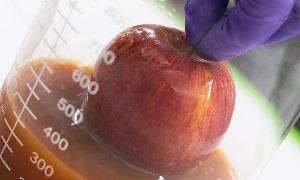
Fruit and vegetable suppliers rely on organic coatings to help preserve and protect the produce as it makes its way to grocery stores and supermarkets. Monitoring these coatings typically requires offline chromatographic techniques, which are very accurate but time-consuming and expensive. With careful integration of components, UV-Visible transmission spectroscopy speeds up QC measurements by providing real-time analysis of coating concentration.
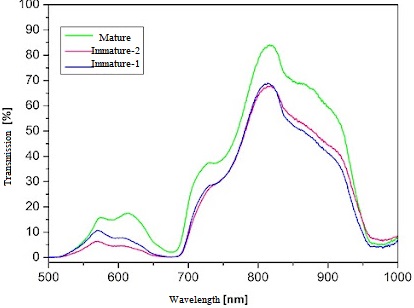
Optosky evaluated several spectrometer setups for transmission measurements of an organic fungicide that delays fruit decay. Extensive testing and analysis in the lab and simulation of factory conditions demonstrated viability for an UV-Visible spectroscopy system, with implementation of certain sample handling and analytical modeling steps to ensure best results.
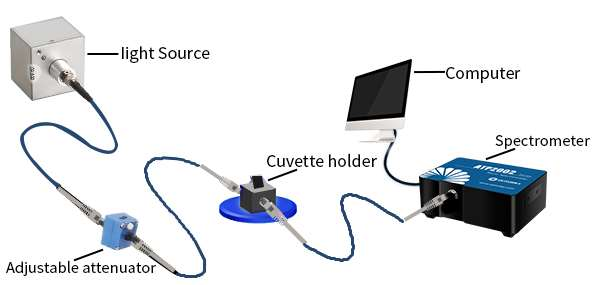
Transmission Measure System:
As population growth strains our capacity to produce enough food, technology such as edible coatings can help to protect food supplies, extend shelf life, and reduce waste. By integrating monitoring methods into process settings, food producers can more effectively deliver safer, healthier and better quality products.
How to Monitor Health of Mobile Biomarkers with Spectroscopy
Absorbance Spectrum Analysis Measure Solution
Related Article

The ATP7810 is a wide-band, high-resolution infrared grating spectrometer covering up to 0.9–5 μm. Featuring a motorized rotating grating, multiple detector options (InGaAs/MCT), and flexible interfaces (SMA905 or free space, USB/UART control), it delivers high SNR and stability for absorption/reflection/transmission spectroscopy, laser wavelength testing, and fiber optic sensing.
New Product Recommendation | ATP7810 Ultra-Wide Range Infrared Spectrometer Series

This study uses the ATP5200P UV-Vis spectrometer to investigate xanthate adsorption on chalcopyrite surfaces. By analyzing absorbance at 300 nm under controlled pH and temperature, the method optimizes flotation conditions for copper recovery, enabling real-time, sensitive detection of adsorption mechanisms in non-ferrous mineral processing.
Using the ATP5200P Spectrometer to Unravel Xanthate Adsorption and Separation Mechanisms
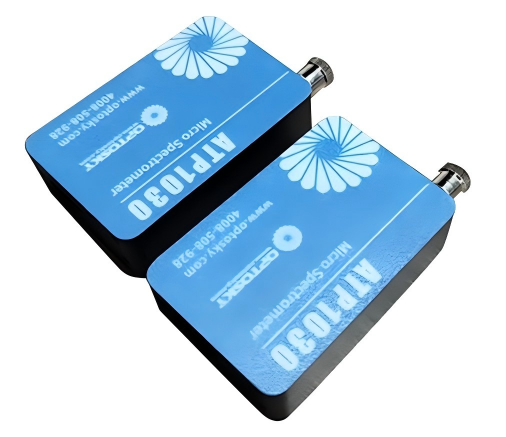
ATP1030 is an ultra‑compact, high‑resolution spectrometer covering 190–1100 nm. With a 1024‑pixel CMOS detector, adjustable integration time down to 1 ms, and USB‑powered design, it delivers reliable performance for applications like online water analysis, color measurement, handheld instruments, and Raman spectroscopy.
Product Recommendation | ATP1030 mini spectrometer Spectrometer

Vis-NIR transmission spectroscopy enables non-destructive identification of infertile duck eggs before incubation, achieving >95% accuracy. By detecting spectral fingerprints (e.g., 836 nm peak for fertile eggs), this method reduces energy waste and improves hatch rates, offering a low-cost, high-throughput solution for modern poultry farming.
Application case | How Spectral Technology is Transforming Duck Egg Farming