
How to Detect COD by UV Spectroscopy
author: Susan
2022-01-04

Chemical oxygen demand (COD) is a chemical method to measure the amount of reducing substances that need to be oxidized in a water sample. COD indicates the degree of pollution of the water body by reducing substances. Therefore, COD is one of the important indicators of water quality testing.
At present, the main detection methods of COD are chemical method and spectroscopy. The chemical method is mainly based on the potassium dichromate method specified in the national standard. In terms of law, it has high sensitivity, no
Requires chemical reagents and other characteristics, spectroscopy has become the current mainstream detection method. As one of the four major spectra, ultraviolet spectroscopy is mainly used for quantitative analysis of molecules and is an important qualitative tool for identifying organic substances. Such COD values are highly correlated. Therefore, UV spectroscopy is the most representative method for detecting COD in spectroscopy. How to use UV spectroscopy to detect COD more accurately has become one of the current research questions for scholars from all over the world.
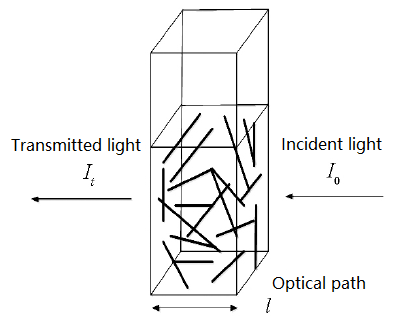
Principle: The Lambert - Beer law is the basic law of absorption spectroscopy. When a beam of parallel monochromatic light passes through a uniform, non-scattering light-absorbing solution vertically, its absorbance A is proportional to the concentration of the light-absorbing solution c and the thickness of the liquid layer (optical path) l. This law is also quantitative by ultraviolet spectroscopy. The theoretical basis of the analysis, the schematic diagram of the Lambert-Beer law is shown in Figure 1, which can be expressed as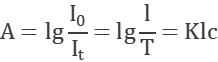
Absorbance:
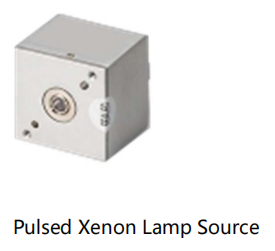
The instrument is the pulsed xenon light source (ATG1030), the central controller, the vertical probe and the full-spectrum optical fiber spectrometer (ATP2000P) produced by Optosky, the needle thermometer, and the electromagnetic heating stirrer, as shown in Figure 2. The experimental use The sample is a COD standard solution formulated in accordance with the potassium dichromate method specified in the national standard.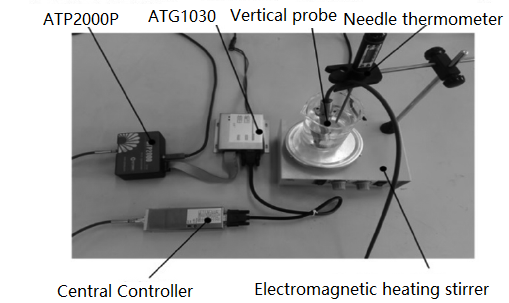
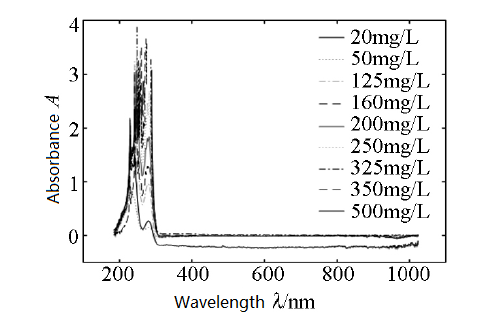
Let the wavelength be λ, it can be seen from Figure 3 that the COD absorbance only has obvious absorption at λ between 185~310nm, and there is no obvious absorption at other wavelength bands, and shows an upward trend at 185~230nm, and a downward trend at 230~264nm. There was an upward trend again at ~290nm, a downward trend at 290~310nm, and almost no absorption after 310nm.
Related Products: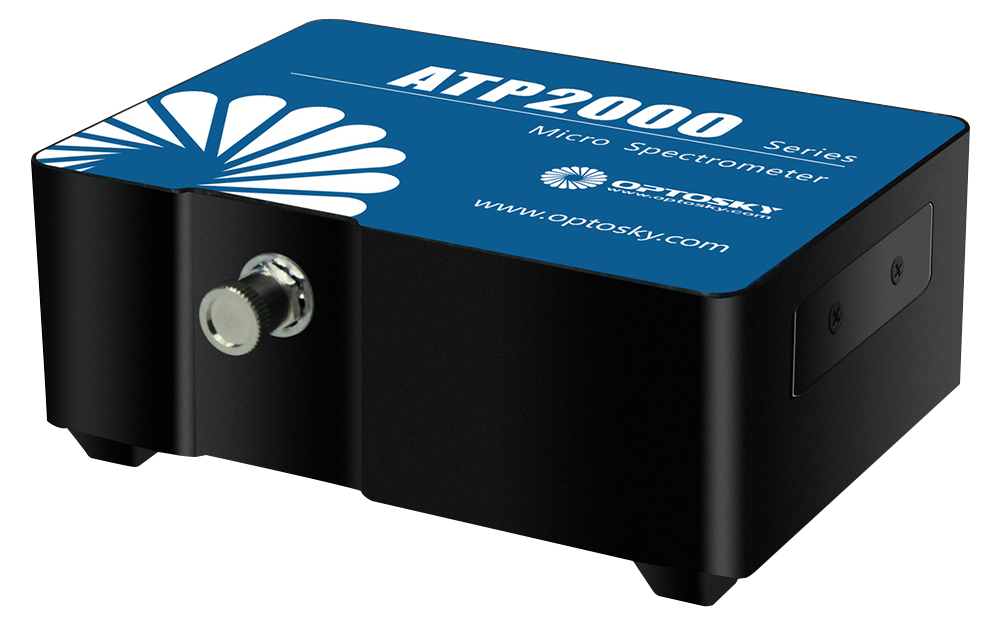
Related Products:
At present, the main detection methods of COD are chemical method and spectroscopy. The chemical method is mainly based on the potassium dichromate method specified in the national standard. In terms of law, it has high sensitivity, no
Requires chemical reagents and other characteristics, spectroscopy has become the current mainstream detection method. As one of the four major spectra, ultraviolet spectroscopy is mainly used for quantitative analysis of molecules and is an important qualitative tool for identifying organic substances. Such COD values are highly correlated. Therefore, UV spectroscopy is the most representative method for detecting COD in spectroscopy. How to use UV spectroscopy to detect COD more accurately has become one of the current research questions for scholars from all over the world.
Principle: The Lambert - Beer law is the basic law of absorption spectroscopy. When a beam of parallel monochromatic light passes through a uniform, non-scattering light-absorbing solution vertically, its absorbance A is proportional to the concentration of the light-absorbing solution c and the thickness of the liquid layer (optical path) l. This law is also quantitative by ultraviolet spectroscopy. The theoretical basis of the analysis, the schematic diagram of the Lambert-Beer law is shown in Figure 1, which can be expressed as
Figure 1 Schematic diagram of Lambert-Beer law
Spectroscopy Solution: Absorbance:
The instrument is the pulsed xenon light source (ATG1030), the central controller, the vertical probe and the full-spectrum optical fiber spectrometer (ATP2000P) produced by Optosky, the needle thermometer, and the electromagnetic heating stirrer, as shown in Figure 2. The experimental use The sample is a COD standard solution formulated in accordance with the potassium dichromate method specified in the national standard.
Figure 2 The complete experimental instrument system
Test Result:
- COD full wavelength spectrum
Figure 3 COD absorption spectra of different concentrations
- Temperature sample spectrum
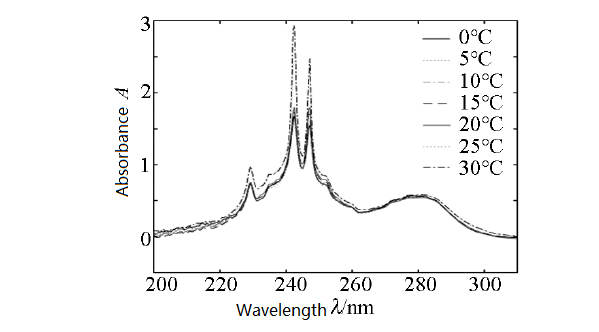
Figure 4 70mg/L COD spectrum with temperature
Conclusion:Let the wavelength be λ, it can be seen from Figure 3 that the COD absorbance only has obvious absorption at λ between 185~310nm, and there is no obvious absorption at other wavelength bands, and shows an upward trend at 185~230nm, and a downward trend at 230~264nm. There was an upward trend again at ~290nm, a downward trend at 290~310nm, and almost no absorption after 310nm.
Related Products:
Related Products:
- “Nonlinear correction of turbidity effect in water quality monitoring by ultraviolet-visible spectroscopy,”
- “Determination of chemical oxygen demand in paper-making wastewater by dual-wavelength ultraviolet spectroscopy,”
- “The Lambert-Beer Law in time domain form and its application,”

Why Surface Water Parameters Measured by Spectroscopy
Different Particle Sizes of Soil Organic Matter on The Spectral Predictionr
Related Article

The ATP7810 is a wide-band, high-resolution infrared grating spectrometer covering up to 0.9–5 μm. Featuring a motorized rotating grating, multiple detector options (InGaAs/MCT), and flexible interfaces (SMA905 or free space, USB/UART control), it delivers high SNR and stability for absorption/reflection/transmission spectroscopy, laser wavelength testing, and fiber optic sensing.
New Product Recommendation | ATP7810 Ultra-Wide Range Infrared Spectrometer Series

This study uses the ATP5200P UV-Vis spectrometer to investigate xanthate adsorption on chalcopyrite surfaces. By analyzing absorbance at 300 nm under controlled pH and temperature, the method optimizes flotation conditions for copper recovery, enabling real-time, sensitive detection of adsorption mechanisms in non-ferrous mineral processing.
Using the ATP5200P Spectrometer to Unravel Xanthate Adsorption and Separation Mechanisms
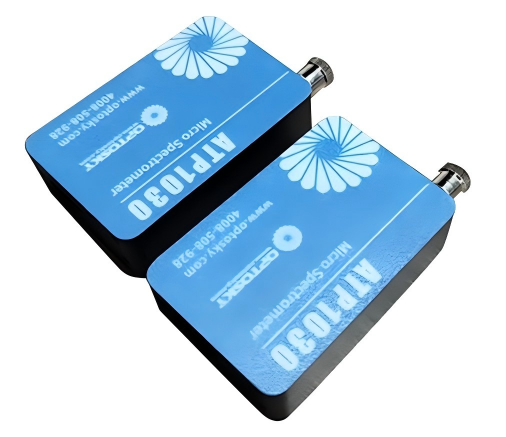
ATP1030 is an ultra‑compact, high‑resolution spectrometer covering 190–1100 nm. With a 1024‑pixel CMOS detector, adjustable integration time down to 1 ms, and USB‑powered design, it delivers reliable performance for applications like online water analysis, color measurement, handheld instruments, and Raman spectroscopy.
Product Recommendation | ATP1030 mini spectrometer Spectrometer

Vis-NIR transmission spectroscopy enables non-destructive identification of infertile duck eggs before incubation, achieving >95% accuracy. By detecting spectral fingerprints (e.g., 836 nm peak for fertile eggs), this method reduces energy waste and improves hatch rates, offering a low-cost, high-throughput solution for modern poultry farming.
Application case | How Spectral Technology is Transforming Duck Egg Farming